×
Indiana University · Luddy School of Informatics & Computing

Designing a Mobile App
for Neonatal Kangaroo
Care
in Low-Resource Settings

A UX research and design initiative at Indiana University: building NeoRoo, a mobile health platform connecting parents and clinicians around premature newborn care to reduce neonatal mortality through Kangaroo Mother Care.
Role
UX Researcher & Designer
Timeline
Aug 2022 – Dec 2023
Tools
Figma · Sketch · Miro
Published
PLOS Digital Health
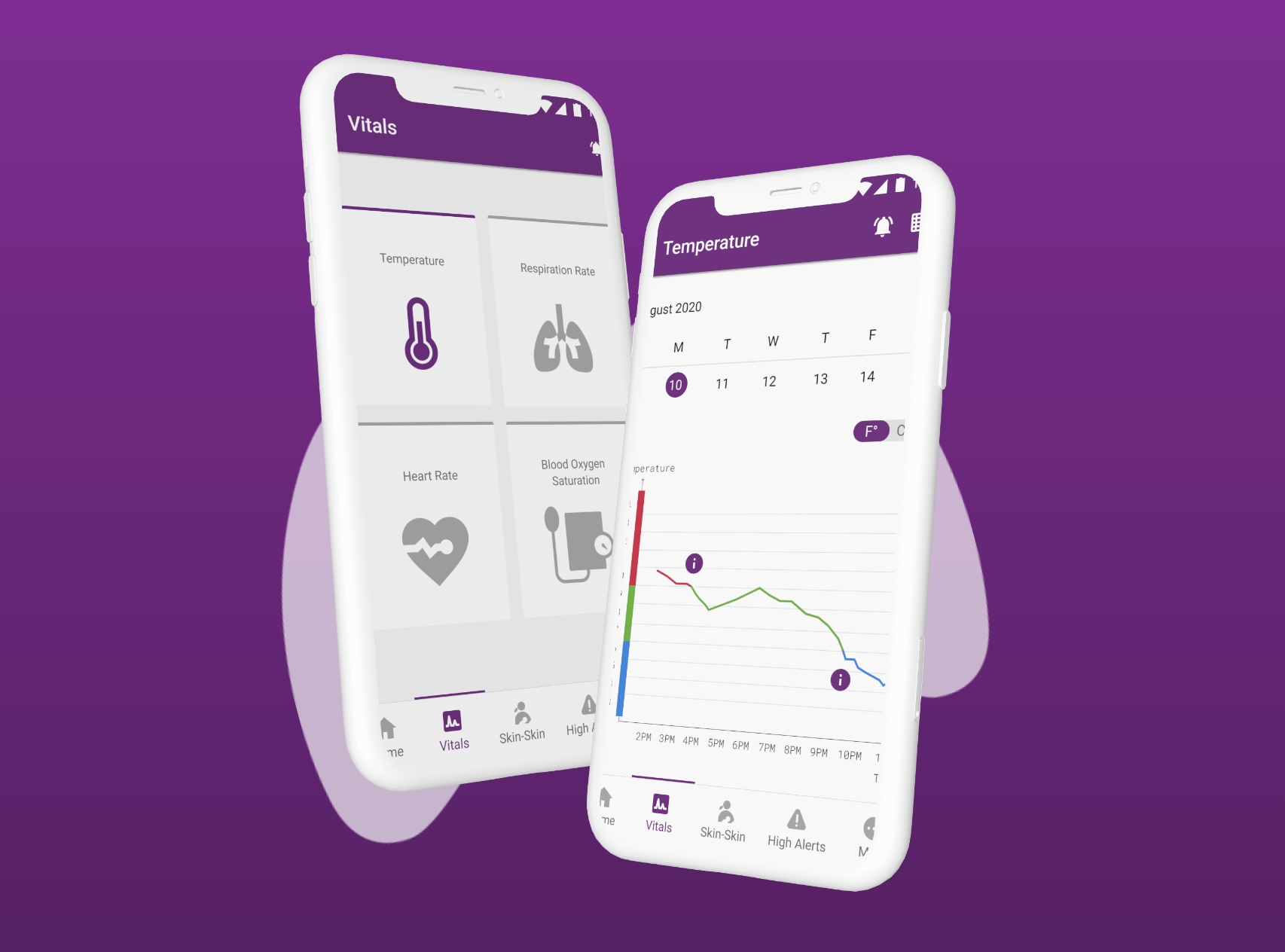
NeoRoo App: Vitals Dashboard
Team
IU Research Lab Me as UX Researcher & Designer
Duration
16 Months Aug 2022 – Dec 2023
Tools
Figma · Sketch Miro · Affinity Mapping
Research Scale
35+ Participants Healthcare staff & real customers
01: The Problem

2.5 Million Neonatal Deaths Every Year

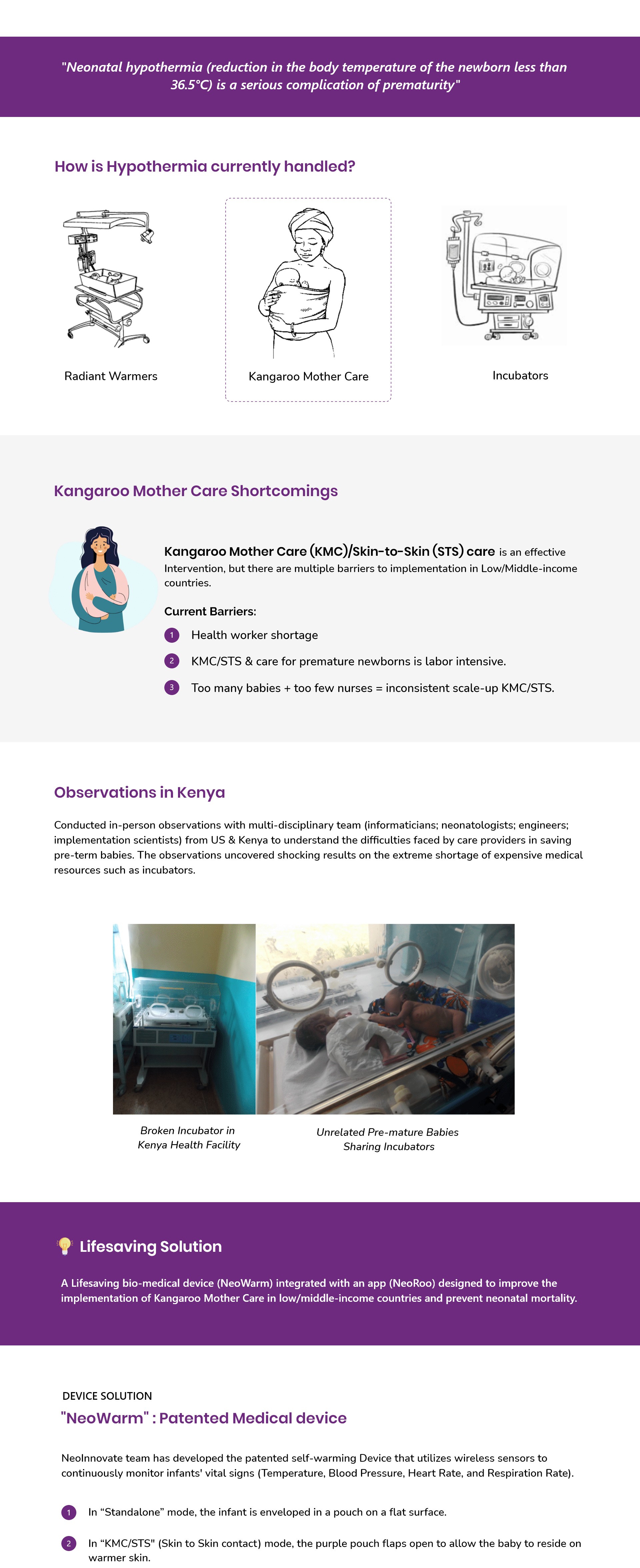
Premature birth is a global crisis concentrated in low-resource settings. Neonatal hypothermia affects 17 million newborns annually, and nurse-to-baby ratios in Kenya reach 1:25: making continuous monitoring impossible without a digital solution.
2.5M
Neonatal deaths globally per year: many preventable with proper monitoring
15M
Premature births annually: 90% occur in LMICs with the least clinical infrastructure
85%
Hypothermia rate in parts of Sub-Saharan Africa where nurse-to-baby ratio can be 1:25
Core Problem
No scalable system exists to continuously monitor premature babies' vitals and simultaneously support parents in Kangaroo Mother Care: a proven, low-cost intervention when practiced consistently.
NeoRoo: Neonatal hypothermia problem context and KMC shortcomings
02: The Solution

NeoWarm: The Patented Biomedical Device

NeoRoo connects to NeoWarm, a sensor-enabled wearable carrier that monitors four vital signs continuously via Bluetooth Low Energy. The device works in two modes: KMC/Skin-to-Skin mode (flaps open for skin contact) and standalone thermal protection mode.
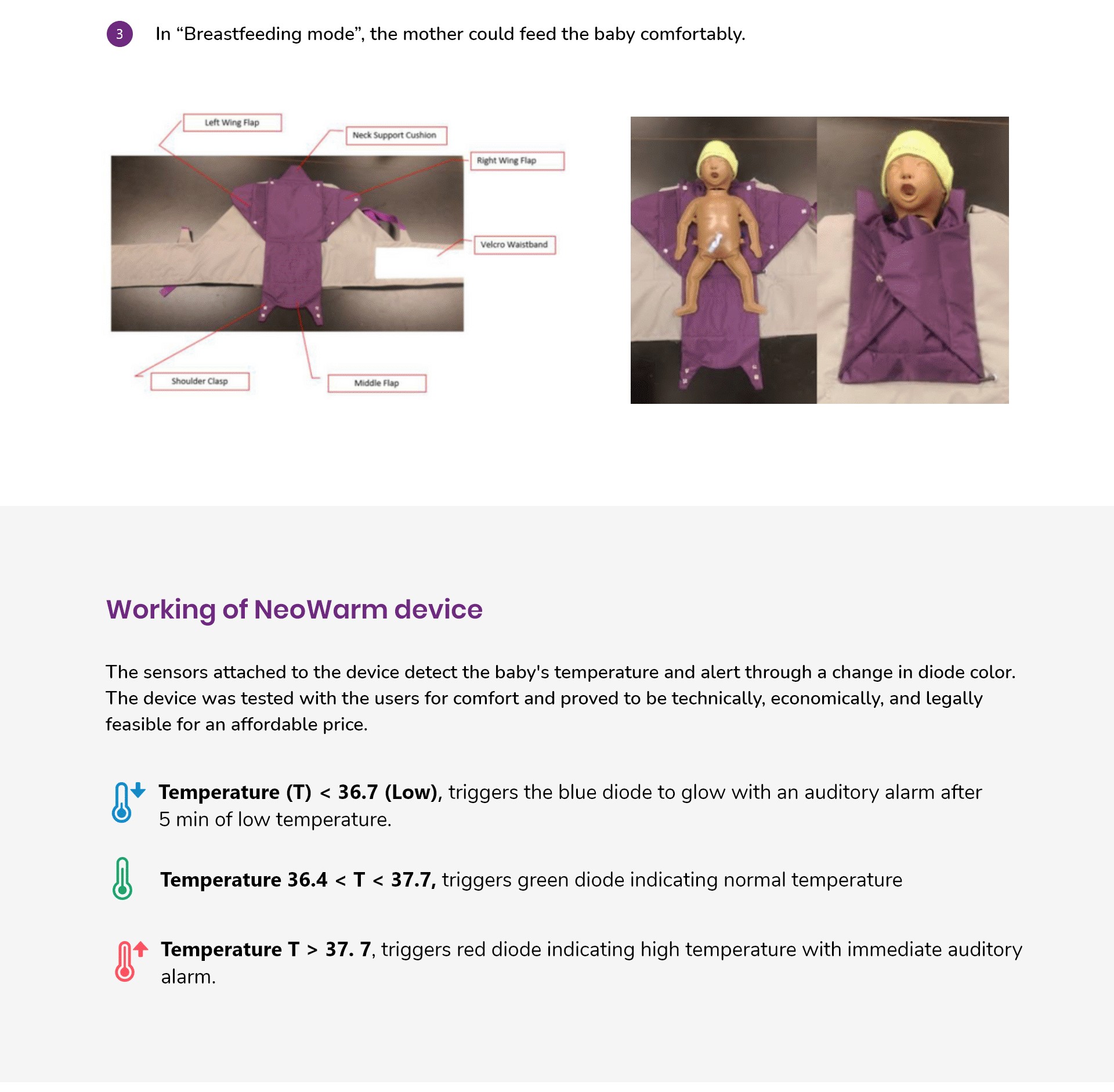
  • Temperature monitored continuously with audio + visual alerts at thresholds
  • Heart Rate, Respiration & SpO₂ streamed in real time to both parent and provider views
  • Skin-to-Skin mode: carrier flaps open so baby rests skin-to-skin on parent's chest
  • Standalone mode: flaps snap closed for thermal protection without a caregiver present
NeoWarm biomedical device: modes and temperature thresholds
03: Design Process

Sketching Flows & Identifying User Pain Points

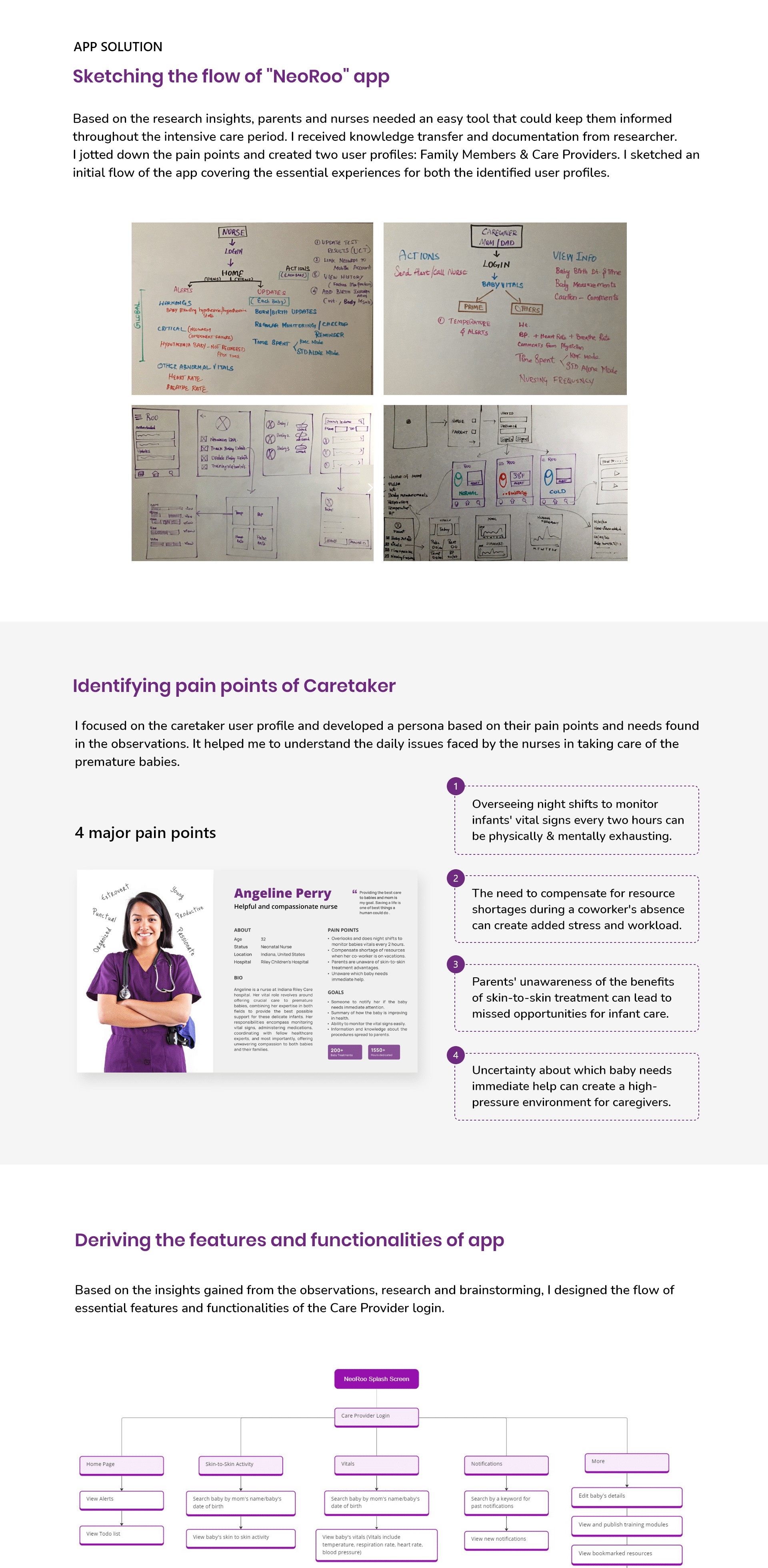
Based on research and observations, I mapped the app flow on paper and whiteboard: covering both Family and Care Provider journeys. I then developed a caretaker persona grounded in the 4 major pain points surfaced from field research.

Discover
Literature review, field observation, expert interviews
Define
Personas, pain points, journey maps, HMW statements
Wireframe
Paper sketches, app flow, information architecture
Prototype
High-fidelity Figma prototypes, colour-coded vitals
Validate
25+ participatory design sessions, qualitative analysis
04: Pain Points of Caretaker

4 Major Pain Points Surfaced from Field Research

I developed a caretaker persona: Angeline Perry, a compassionate NICU nurse: grounded in direct observations and contextual inquiry. Four critical pain points emerged that became the foundation for every feature decision in NeoRoo.
Pain Point 01
Physical & Mental Exhaustion
Overseeing night shifts to monitor infants' vital signs every two hours can be physically and mentally exhausting for caretakers.
Pain Point 02
Resource Shortage Stress
Compensating for resource shortages during a coworker's absence creates added stress and increased workload with no support system.
Pain Point 03
Parents Unaware of KMC Benefits
Parents' unawareness of the benefits of skin-to-skin treatment leads to missed opportunities for kangaroo care and slower infant recovery.
Pain Point 04
High-Pressure Triage Uncertainty
Uncertainty about which baby needs immediate help creates a high-pressure environment that slows response time and elevates caregiver anxiety.
NeoRoo: Caretaker persona Angeline Perry with 4 pain points
05: Features & Functionalities of App

Deriving Features from Pain Points

Based on the pain points and insights from field observations, I designed the essential features and functionalities of NeoRoo for both the Family and Care Provider login flows. Each feature maps directly to a caretaker pain point.

Vitals Dashboard
Real-time monitoring of Temperature, Respiration Rate, Heart Rate & SpO₂ with colour-coded traffic-light alerts.
Skin-to-Skin Activity
Visual KMC tracking chart with daily/weekly hour goals for parents and nurses to log skin-contact sessions.
Baby List
Searchable HCP view of all infants under the current shift with live vitals, DOB, and weight at a glance.
High Priority Alerts
Tiered notification system surfacing critical cases in a to-do task list so nurses act on the right baby first.
Training Modules
226 downloadable educational videos in 109 languages for families and providers on KMC and neonatal care.
Vitals Trend Graph
Clickable temperature curve with date-picker navigation for reviewing historical vital sign data across days and weeks.
NeoRoo: App features and functionalities flow diagram
06: Information Architecture

App Structure & Vital Signs Monitoring

I designed the full information architecture covering both the Family and Healthcare Provider flows. The bottom-tab navigation was chosen because it matched both users' mental models: care categories, not data streams.

NeoRoo monitors four vital signs critical for premature newborns: Respiration Rate (with apnea detection), Blood Oxygen Saturation, Body Temperature, and Heart Rate.
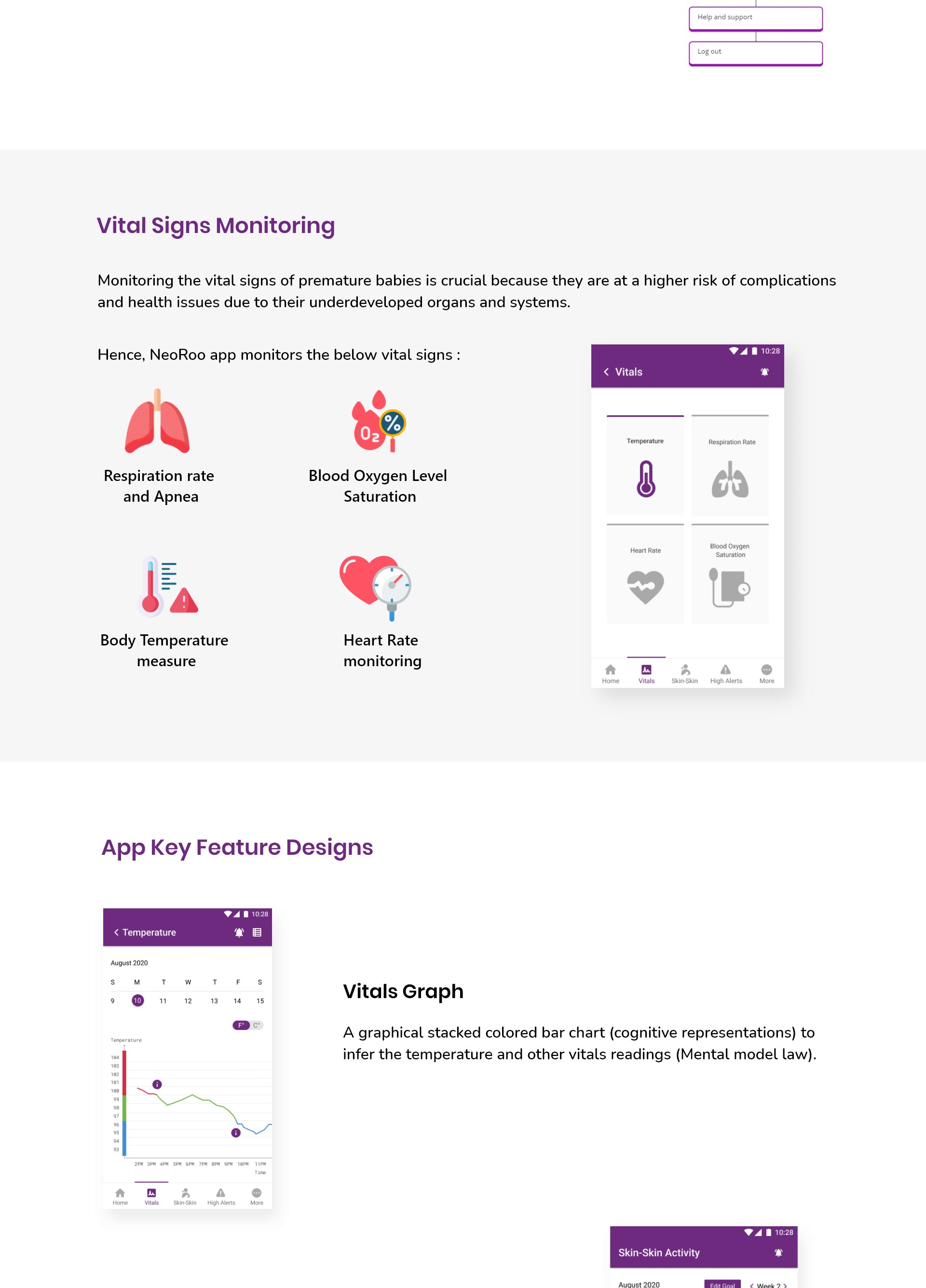
Design principle: The traffic-light colour schema (Green / Yellow / Red) from WHO/AAP curricula was adopted throughout: enabling recognition over recall and reducing cognitive burden for both parents and nurses.
Green
Normal: routine care continues
Yellow
Caution: nurse review recommended
Red
Emergency: immediate intervention
NeoRoo: Information architecture and vital signs monitoring design
07: App Key Features

Skin-to-Skin, Baby List,
Alerts & Training

The four core feature screens beyond the vitals dashboard each solve a specific pain point uncovered in research:
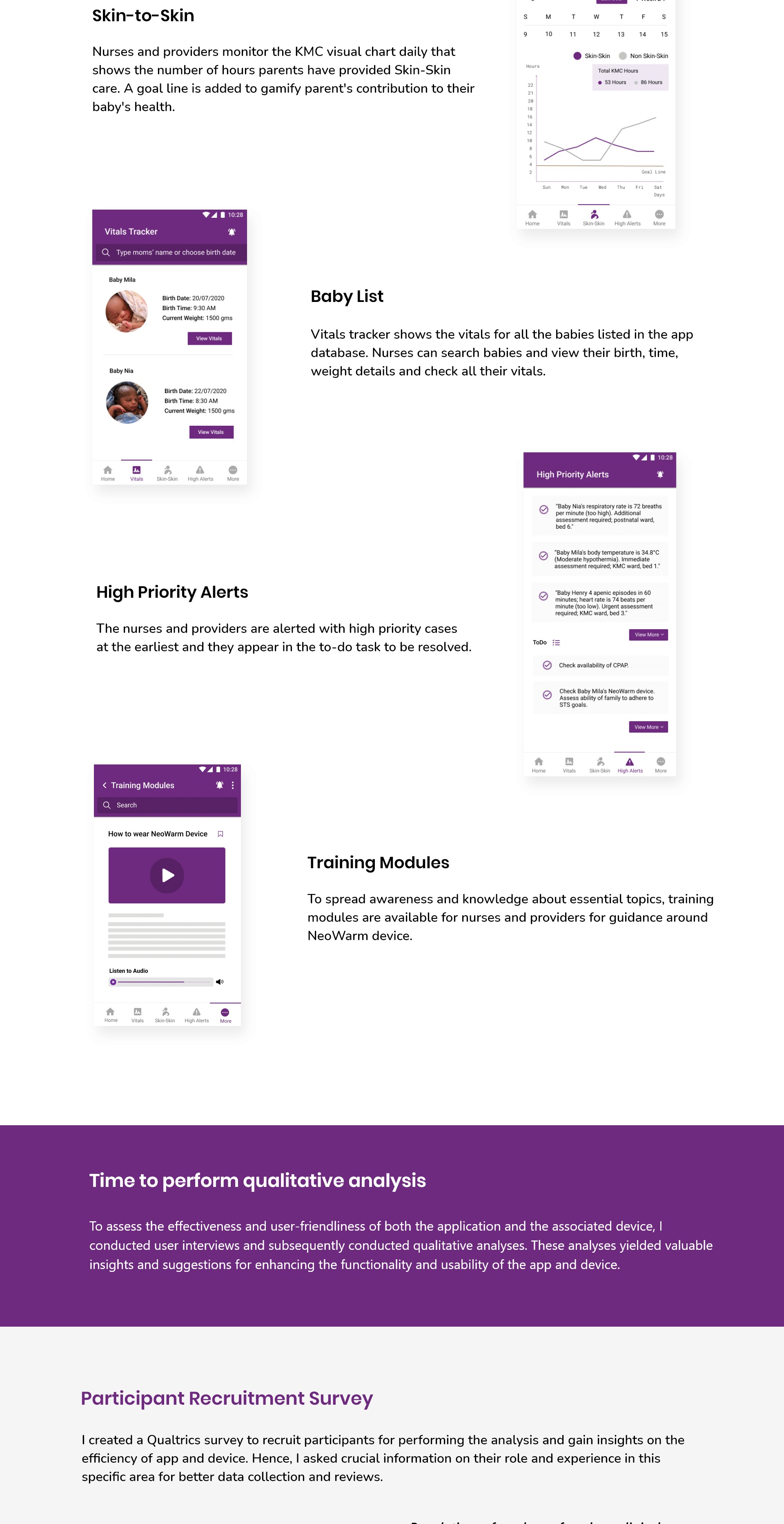
  • Skin-to-Skin: Visual chart showing KMC hours. Parents and nurses can track daily/weekly skin contact duration and set shared goals
  • Baby List: HCP view showing all infants under the current shift with real-time vitals status, name, date of birth, and weight. Searchable for large wards
  • High Priority Alerts: Nurses and providers are alerted with high-priority cases at the earliest, appearing in the to-do task list to be resolved
  • Training Modules: 226 downloadable educational videos in 109 languages to spread awareness and knowledge about essential topics for families and providers
NeoRoo: Skin-to-Skin, Baby List, High Priority Alerts, Training Modules screens
08: User Research

Participant Recruitment Survey & Participatory Design Interviews

I created a Qualtrics survey to recruit participants for the qualitative analysis: gathering information on their role and experience in the clinical settings where NeoRoo would be deployed.

I then performed 25+ participatory design interviews to understand how caretakers treat the premature babies, monitor their vitals, and what issues they face while this process. I showed them the NeoWarm device and NeoRoo app to get their opinion on whether the device and app would be useful and helpful to manage treatment efficiently in their experience.
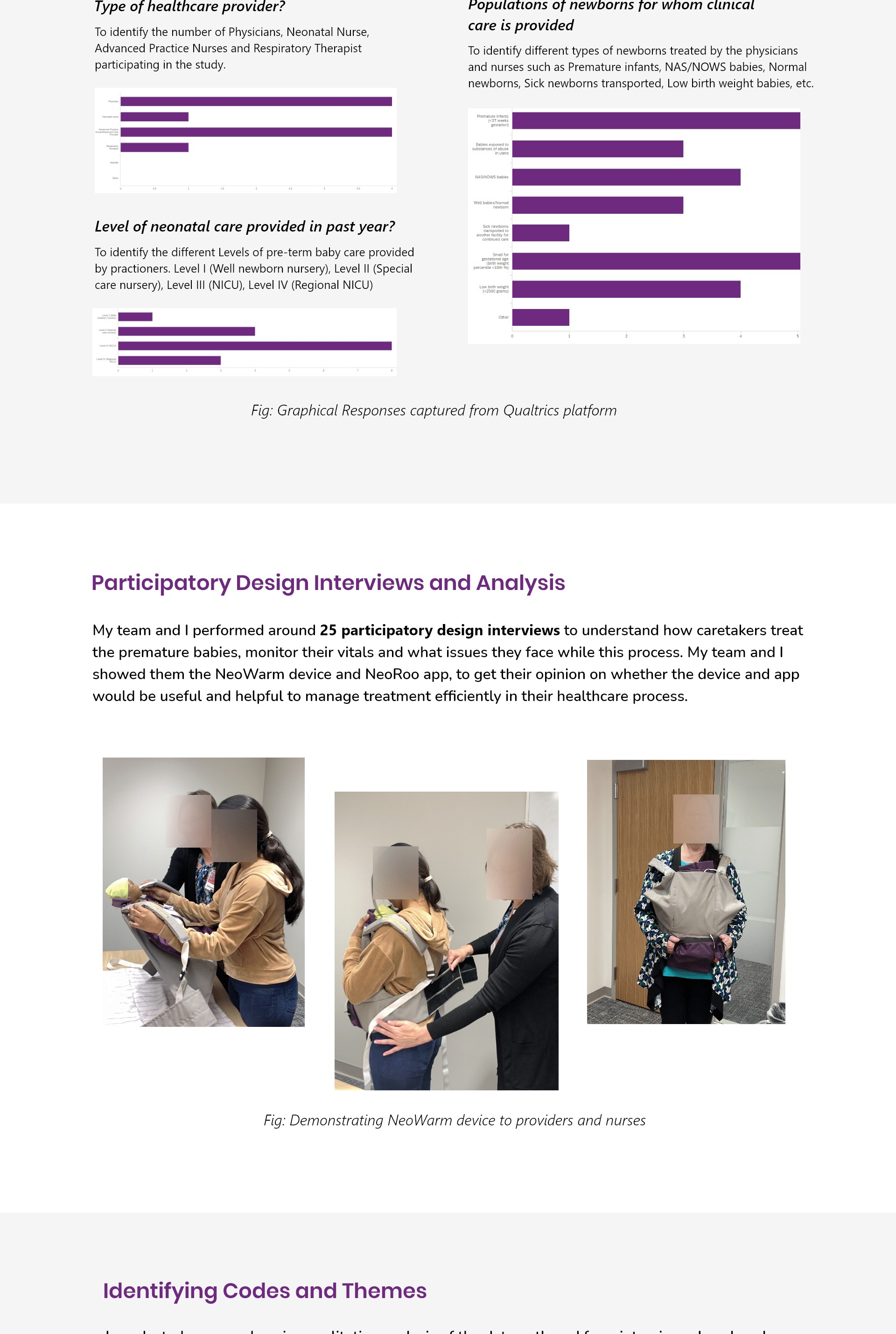
Research setting: Indiana University–Kenya Global Health Equity Partnership · 300+ Ministry of Health facilities across 17 counties in Western Kenya.
NeoRoo: Participant survey, participatory design interviews with clinicians
09: Research Findings

Key Insights That Shaped the Design

Through contextual inquiry and participatory design sessions with 35+ healthcare professionals and real customers, these insights drove every design decision.

Parents excluded from care data
Families had no real-time access to their baby's vitals. Updates came only from verbal nurse check-ins: infrequent and anxiety-inducing.
Nurses overwhelmed by communication
At 1:7–25 nurse-to-baby ratios, staff spent significant shift time relaying routine vitals to parents: time that should go to direct care.
KMC tracking was paper-based and lost
Kangaroo care sessions were logged manually from memory at end of shift. Critical care data was frequently lost or inaccurately recorded.
Alert fatigue was an active risk
Without tiered notifications, too many low-priority alerts caused both parents and staff to disengage: making the system counterproductive.
Recognition over recall for low-literacy users
Interfaces relying on text labels failed. WHO-aligned traffic-light colour coding and iconography enabled status recognition without reading.
Offline functionality non-negotiable
Inconsistent internet access in many facilities meant the app had to function fully offline, syncing automatically when connectivity returned.
"
I want to know my baby is warm and breathing. I cannot be at the hospital every hour: but I need to know.
Parent · Contextual Interview P3
"
We are one nurse for fifteen babies sometimes. There is no time to walk to each family and explain the readings every shift.
NICU Nurse · Field Observation P11
"
The parents want to do kangaroo care. But if no one tracks it, the data disappears by morning handover.
Neonatologist · Expert Interview P7
10: Qualitative Analysis

Identifying Codes, Themes & Design Improvements

After conducting 25+ interviews, I analysed the data using inductive coding: identifying types of codes such as in-vivo, structural, and value codes using the Atlas.ti tool. This analysis helped me identify different types of pain points and then generated suggestions to address them.

Based on codes and themes from the qualitative analysis, I came up with design improvements and suggestions for NeoRoo app and NeoWarm device. These suggestions elevated both the app's usability and the device's functionality.
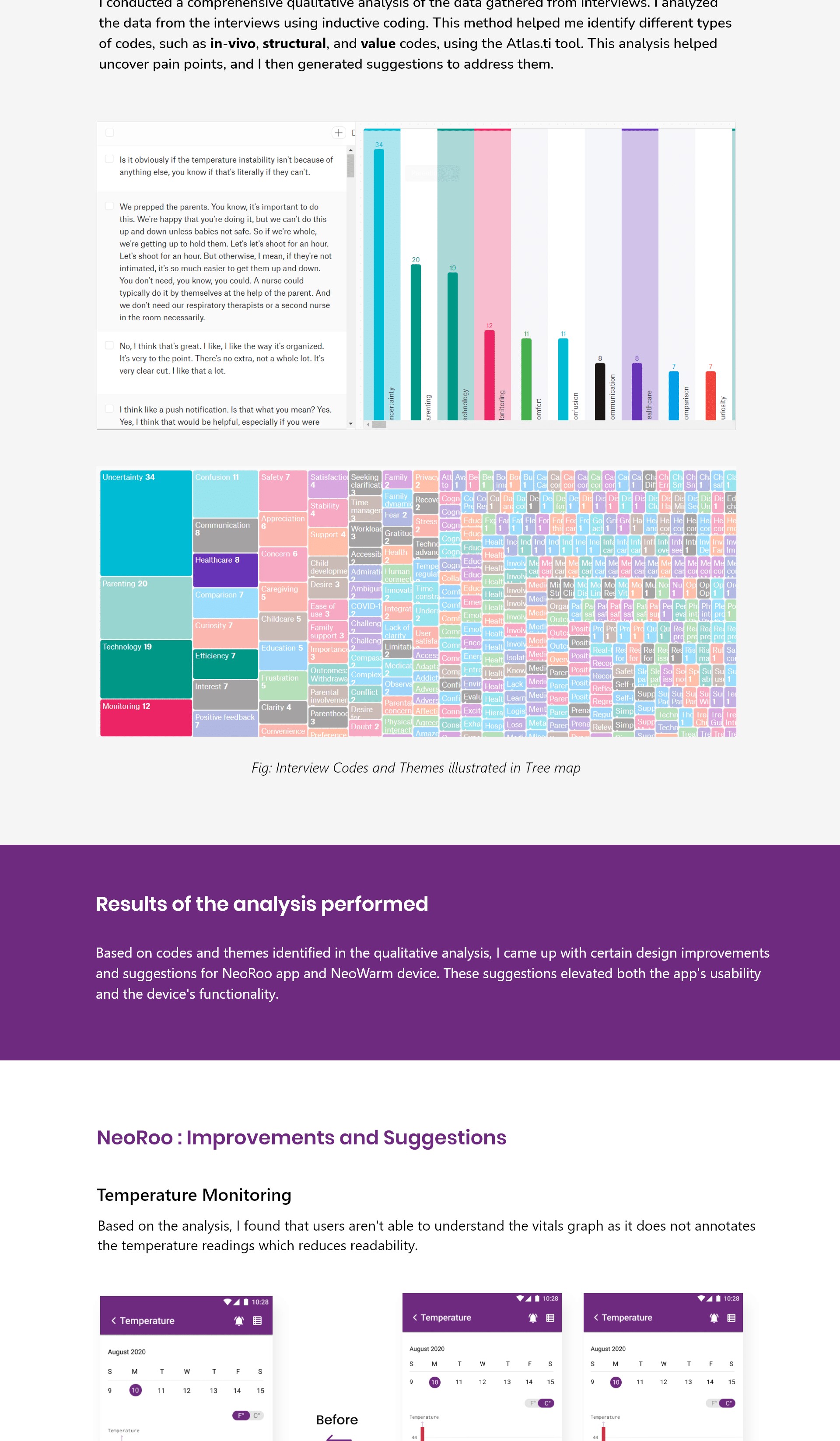
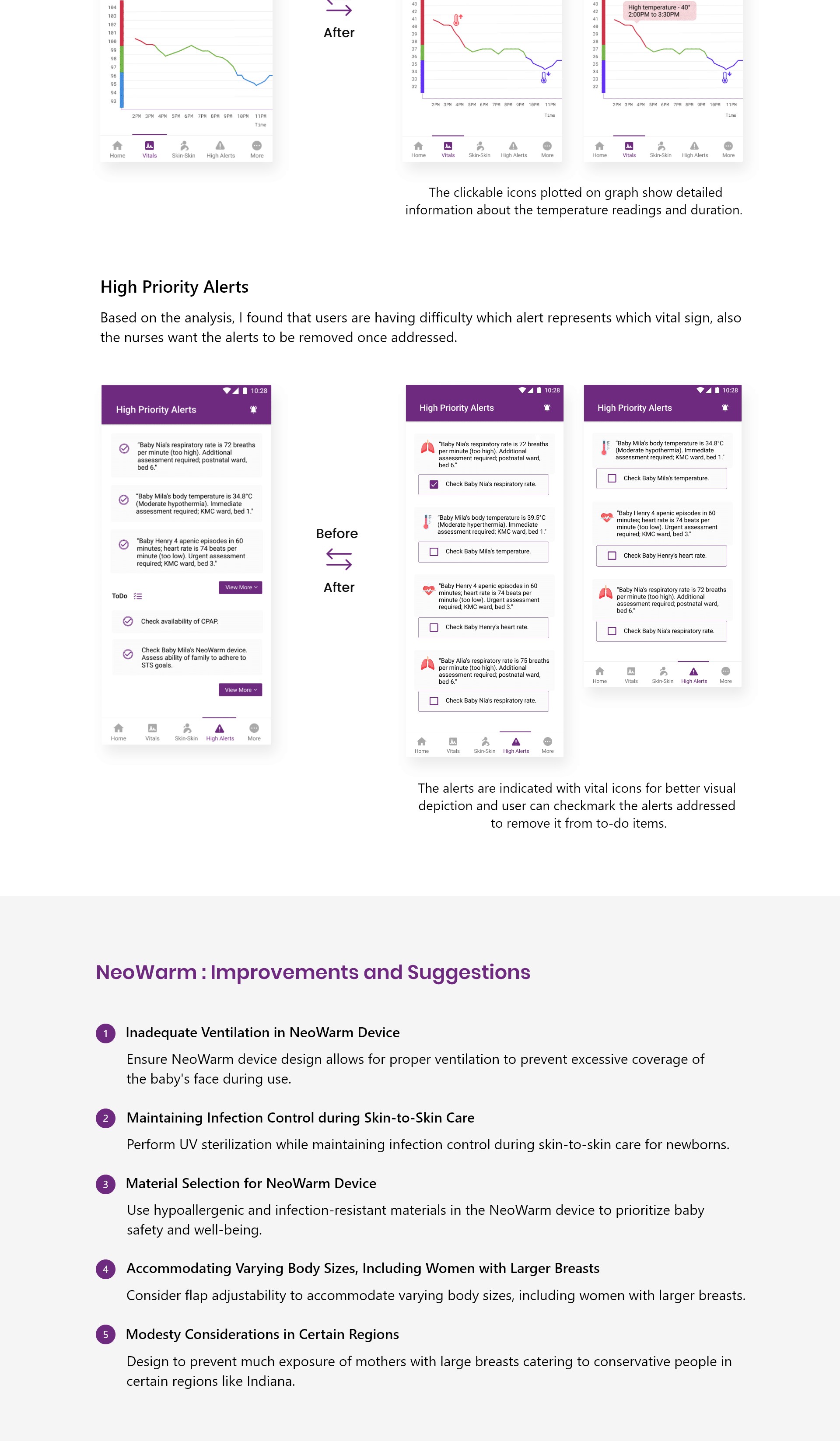
  • Temperature Monitoring: Users couldn't understand the vitals graph. Redesigned with a clickable curve plotted on graph for detailed temperature readings and duration
  • High Priority Alerts: Alerts indicated with tick icons for clearer visual depiction. Added option to remove from to-do list once addressed
  • 35% improvement in process efficiency validated through stakeholder review cycles
NeoRoo: Interview codes and themes tree map, qualitative analysis results
11: Design Improvements

Before & After: Temperature & Alert Redesigns

The qualitative analysis directly drove two key interface redesigns: the temperature trend view and the high priority alert system: both validated through follow-up participatory sessions.
Before
Temperature Monitoring Issues
  • Users couldn't understand the vitals graph: no way to see specific readings at specific times
  • No duration information: impossible to track how long temperature was outside safe range
  • Alert icons were ambiguous: users didn't know which alerts required immediate action
After
Redesigned for Clarity
  • Clickable curve plotted on graph: tapping shows exact temperature reading and duration
  • Calendar date-picker added for navigating historical trend data across days and weeks
  • Alert icons replaced with tick icons for clearer visual hierarchy: option to remove resolved items from to-do list
NeoRoo: Before and after: Temperature monitoring and High Priority Alerts redesign
Outcome: These redesigns delivered a 35% improvement in process efficiency for healthcare staff, validated across stakeholder review cycles and follow-up participatory design sessions.
12: Results & Impact

The Impact

The NeoRoo research was published in PLOS Digital Health (2023). The design work was validated through iterative participatory cycles with clinical staff, reducing manual coordination overhead and improving care process efficiency.

35%
Improvement in process efficiency for healthcare staff: reduced manual communication overhead and time spent relaying vitals to families
35+
Healthcare professionals and real customers engaged through contextual inquiry, interviews, and prototype validation sessions
7
App modules delivered: vitals monitoring, trend graphs, KMC goal-setting, messaging, educational resources, task management, clinical history
Published in PLOS Digital Health · 2023
Bucher SL, Young A, Dolan M, et al. "The NeoRoo mobile app: Initial design and prototyping of an Android-based digital health tool to support Kangaroo Mother Care in low/middle-income countries." Funded by Indiana Clinical and Translational Sciences Institute and NIH Award UL1TR002529.
13: Reflection

Challenges & Key Learnings

Challenges

  • Recruiting clinical staff during active care hours required careful scheduling and sensitivity to their workload
  • Designing for low-literacy users with inconsistent digital experience: conventional UX patterns frequently failed in this context
  • Balancing information richness vs cognitive simplicity: every additional data point had clinical value but risked overwhelming stressed users
  • Serving two emotionally distinct users (anxious parents, task-focused nurses) through shared interface components in a single app

Key Learnings

  • Global health UX demands extraordinary contextual humility: assumptions built for high-income, high-literacy users fail systematically in LMICs
  • Participatory design isn't optional when the stakes are neonatal mortality: real clinical input changes what gets built, not just how it looks
  • Recognition-based design (colour, iconography) consistently outperformed text-heavy interfaces in usability testing across literacy levels
  • The "know-do gap" is a design problem: people want to do the right thing; they need the right information, at the right time, in the right form

Interested in working together?

Let's talk about healthcare UX, research-driven design, or your next product challenge.

Get in Touch All Projects LinkedIn