"Experience the world beyond your limitations!"
An Augmented Reality-based cultural tourism platform designed for mobility-disabled people: bringing the world's heritage sites into their own surroundings through 360° live experiences.
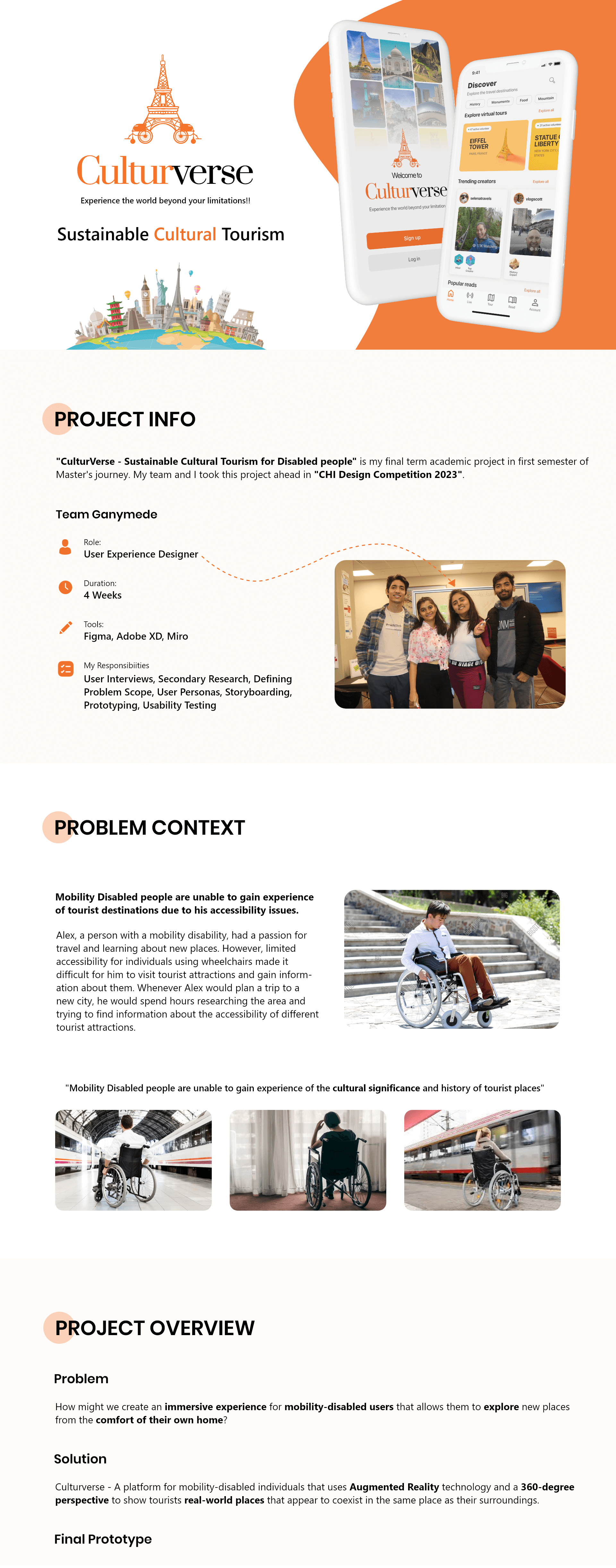
A person with a mobility disability has a reason to travel and learn about new places. However, limited accessibility for wheelchair users makes it difficult: often impossible: to visit tourist attractions and gain cultural experiences.
These issues make it challenging to experience new cities. People spend hours researching accessibility information only to find they still can't visit: making cultural exploration feel out of reach.
How might we create an immersive experience for mobility-disabled users that allows them to explore new places from the comfort of their own home?
CulturVerse: a platform that uses Augmented Reality technology and 360° perspective to let mobility-disabled users experience real-world cultural places in their own surroundings.
Secondary research and user surveys uncovered the true magnitude of the accessibility gap in cultural tourism for mobility-disabled populations globally.
A structured 5-stage process keeping us grounded in real user needs while exploring bold, accessible solutions.
Two primary personas guided every design decision: ensuring both the mobility-disabled traveler and the local volunteer guide had seamless, purposeful experiences.
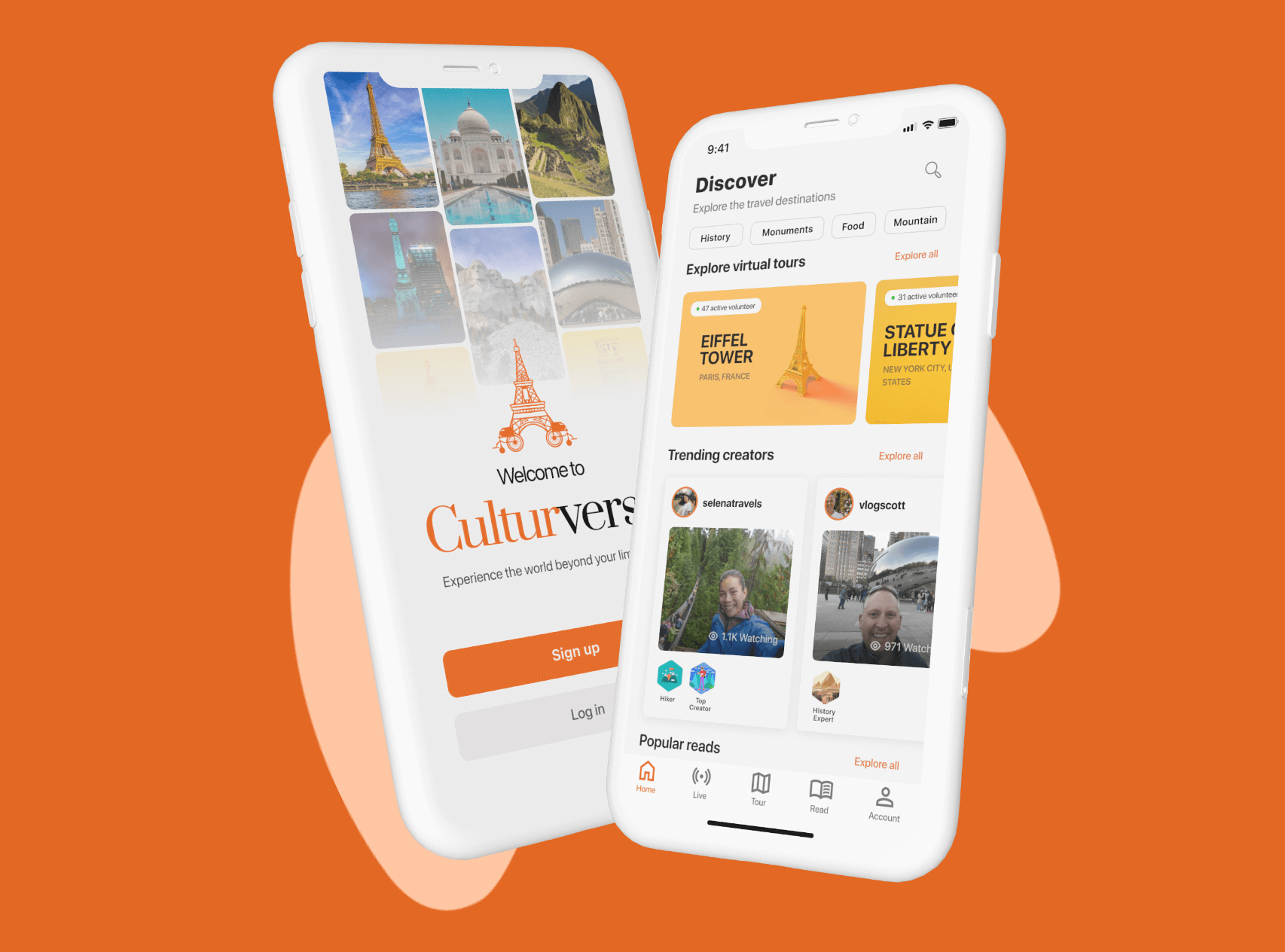
The final hi-fidelity prototype shows the complete user journey: from discovering virtual tours to joining a live 1-to-1 session with a volunteer guide and experiencing landmarks in 360° AR.
Four essential flows that make CulturVerse unique: each designed with accessibility, simplicity, and authentic human connection at its core.
A curated feed of cultural destinations organised by category: Monuments, Food, Mountains and more. Each tour card shows a live preview, creator rating, and accessibility details so users can plan with confidence.
Using the phone camera, users see real-world landmarks overlaid directly into their surroundings through AR. The 360° immersive view lets them look around the site as if they were physically there: no travel required.
A 1-to-1 live session with a local volunteer guide who walks users through the cultural site in real time. Authentic storytelling, genuine local knowledge: the antithesis of scripted, pre-recorded content.
Volunteer guides have rich profiles with their specialties, ratings, and upcoming tour schedules. Users can browse, follow creators, and book a private session: directly supporting local communities financially.
CulturVerse's visual language is warm, vibrant, and inclusive: reflecting cultural energy while maintaining strong accessibility contrast ratios.
Apps like YouTube and Instagram generate content for millions but deliver zero personal connection. CulturVerse is focused on authentic 1-to-1 experiences with real local volunteers.
Google Maps shows routes. CulturVerse provides live, human-guided cultural narratives with authentic local context and personal storytelling.
YouTube delivers pre-recorded content to millions. CulturVerse connects you 1-to-1 with a local guide in real time: all authenticity, no script.
Instagram Live is entertainment. CulturVerse financially supports local communities: every virtual tour directly contributes to guide incomes.
We conducted user testing with 10 participants using User Testing and Expert Testing methodologies to identify usability gaps and validate design decisions.
Hi-fidelity app screens tested with users
We conducted System Usability Testing with 10 users and calculated the SUS score for CulturVerse using the standardised 10-question scale.
Based on testing feedback and evaluation results, three key improvement areas were identified for the next development cycle.
Four weeks of accessibility-focused design taught me lessons that go far beyond this project.
I learned to communicate with my team on a regular and clear basis, and to listen carefully to understand all points of view. Cross-functional collaboration is not a soft skill: it's a design skill.
Working with people from various backgrounds provided valuable opportunities to learn from others and consider different viewpoints: leading to more inclusive and well-rounded solutions.
We kept revisiting our problem statement through interviews and data gathering. Based on observations and group discussion, we narrowed our approach to provide a meaningful, user-friendly experience.
🎓 The final academic project was a great success.
Cheers, Team Ganymede! 🧡Liked this project? Let's talk design, accessibility, or your next challenge.